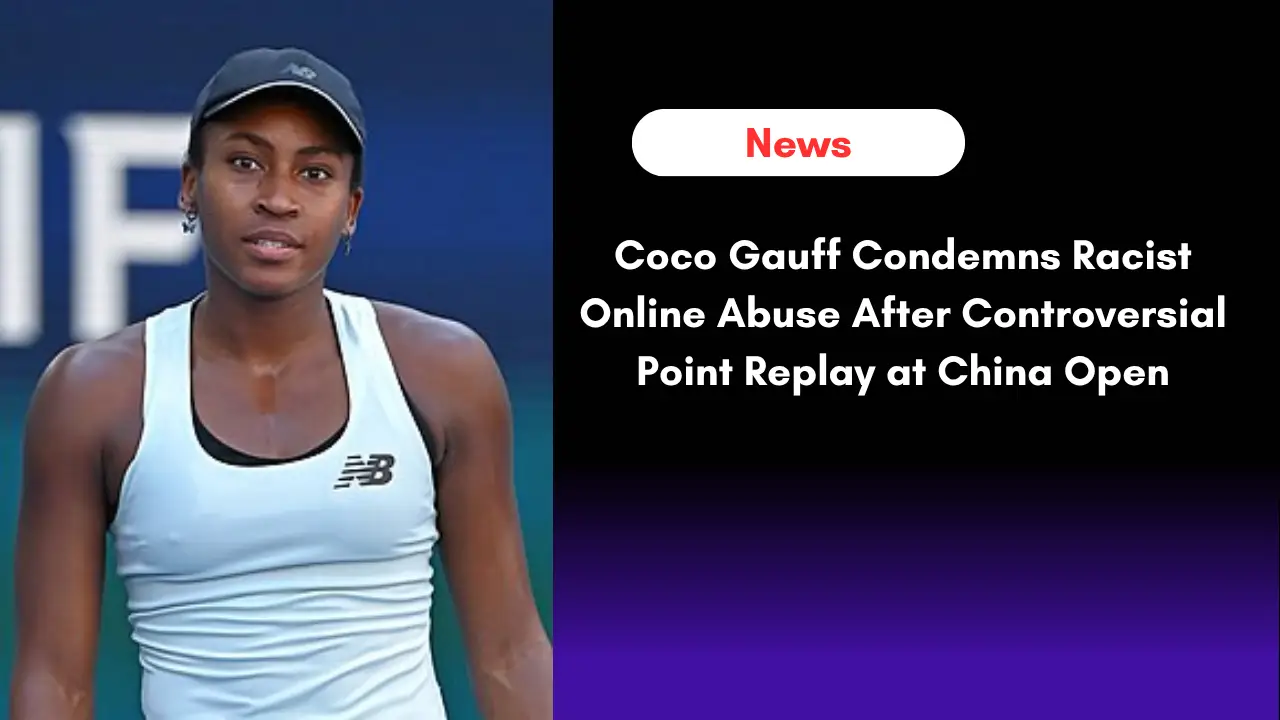
American tennis star Coco Gauff has spoken out against a wave of racial abuse directed at her on social media following her victory over Chinese teenager Sun Xinran at the China Open in Beijing.
The two-time Grand Slam champion defeated the 16-year-old local player 7-5, 6-1 on Monday to advance to the fourth round. The match, however, became the subject of intense online scrutiny after a disputed point in the first set.
Serving at a critical stage, Gauff stopped play by raising her hand to flag a flickering advertising board just as Sun appeared set to hit a winner. After a video review, the umpire ruled that the distraction constituted a hindrance and ordered the point to be replayed. Gauff won the replayed point, held serve to level at 5-5, and went on to dominate the rest of the match.
Gauff, 22, said she faced an “insane” volume of racist comments and direct messages in the hours after the match. Responding on X (formerly Twitter) early Tuesday to a post that included a racial slur, the Black American player wrote: “You can dislike me or disagree about what happened without being racist. The amount of racist comments/direct messages I’ve received in the last few hours is insane. Lastly, I’m not a cheater or a thief.”
She emphasized that she had acted within the rules. Players are permitted to request video reviews for certain judgment calls, including potential distractions that may have interfered with play. Gauff noted that she had discussed the incident with Sun at the end of the match.
“Xinran’s an incredible talent and player, I apologised for the situation at the end of the match and she completely understood,” Gauff said. “I didn’t like to see her so emotional as I’ve been there and I really understand what it’s like but this is the beginning of an incredible career. It was an honour to share the court in front of her home crowd.”
Reuters has sought comment from the WTA, women’s tennis’s governing body, and from tournament organizers in Beijing. The WTA has introduced an AI-powered system to monitor social media activity involving thousands of players and officials in an effort to combat online abuse. A joint study by the WTA and World Tennis found that players faced more than 12,000 abusive posts and messages in 2025, a sharp rise from about 8,000 the previous year.
The episode highlights ongoing challenges around online harassment in professional tennis, particularly when high-profile matches involving home favorites generate strong emotions. Gauff’s measured response underscored both her frustration with the racist attacks and her respect for her young opponent.