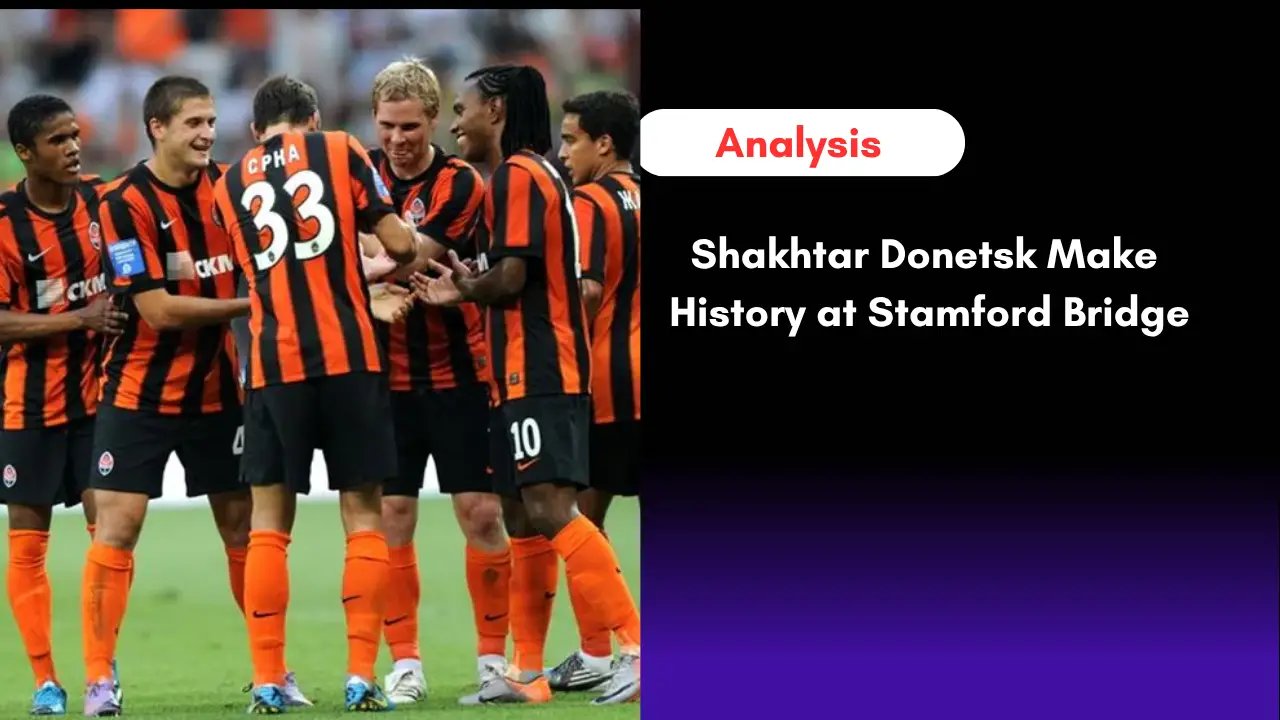
Shakhtar Donetsk have become the first Ukrainian club side to win in England. They came from a goal behind to beat AEK Athens 3-1 at Stamford Bridge in the Champions League.
Substitute Gleiker Mendoza sealed the result with a fine strike into the top corner. Head coach Arda Turan sprinted down the touchline with his fist in the air.
The Athletic spent the week with the squad to see what it takes to play a “home” game in London when your training base is over 1,000 miles away in Lviv.
Turan’s thoughts turn to children back home
After the final whistle, a reporter told Turan that no Ukrainian club side had won in England before. The coach did not dwell on the record. He said he was glad that “we brought smiles to the faces of children who might be under the attacks of bombs and drones”. He rated that above any other success.
Turan is 39. He is a former Turkey international who played for Atletico Madrid and Barcelona, and he has been in the job for just over a year. Days earlier, at the pre-match press conference, he became tearful when asked how he supports his players through the war.
His answer was that the players had taught him. They showed him how to live through war without excuses and to keep fighting, he said. The club does not want to turn it into drama, he explained, but it will keep pointing out that children are dying in Ukraine. “We are living with this, but we do not accept it,” he said.
A night in west London that felt like home
The crowd was 29,144. Former Chelsea and Dynamo Kyiv striker Andriy Shevchenko watched from the stands, as did Mykhailo Mudryk, a 28-time Ukraine international who is on loan at Tottenham.
Before kick-off, the stalls on Fulham Road that usually sell unofficial Chelsea merchandise were offering Shakhtar gear instead, including half-and-half scarves.
Few fans inside were neutral. AEK supporters filled the whole Shed End and made plenty of noise for long spells. In the three stands Chelsea fans normally occupy, though, Shakhtar had the louder backing. Supporters jumped up and down and chanted the club’s name again and again.
Outside the ground, the news was heavy. Ukraine’s president Volodymyr Zelensky was in London for talks with UK prime minister Andy Burnham, and there were fresh reports of a missile attack on Kyiv. The players had to shut that out once the game began.
Turan’s side had promised fight all week, and they delivered it. On the bench, sport management director Vitalii Khlivniuk was the calmest person around. He sat in the front row for all 90 minutes and helped with the substitutions, even using the fourth official’s board at times.
When it ended, the players and staff walked around the pitch to applaud the fans. For many in the party, it felt like a real home night. Head of medicine Volodymyr Oleksiuk left the field grinning broadly.
The win lifts Shakhtar to 11th in the early league-phase table. Bayern Munich are above them on goal difference, and Manchester City and Manchester United are below.
A club that has not seen its own ground since 2014
Russia’s invasion of the Donbass region in 2014 forced Shakhtar out of the Donbass Arena, and they have not been back. Since 2023, their league home games have been staged at Arena Lviv, roughly 750 miles west of Donetsk. Before that, the team spent time playing in Kyiv and Kharkiv.
In Europe, their home games over the last four years have been played in Germany, Poland and Slovenia, a move that followed Russia’s full-scale invasion in 2022. In August, it was confirmed that Stamford Bridge would stage this season’s Champions League home fixtures. The AEK game was the first.
Ten hours, one border and a siren
The party left Ukraine at midday on Saturday: 12 vehicles carrying more than 100 people, with the game still four days away.
First came a coach ride of over 100 miles to Rzeszow-Jasionka Airport in Poland, which Shakhtar use for their European trips. The border is where things can go wrong. When the squad flew to London in May for the Conference League semi-final second leg against Crystal Palace, the crossing took several hours. This time it was done in 90 minutes. “We felt lucky,” Khlivniuk told The Athletic. After a 10-hour trip, the group landed in London at 8pm.
The build-up had already been far from easy. On Friday night, Shakhtar beat Veres Rivne 3-0 in the league. A siren warning of a possible attack interrupted the match, though, and the second half began 20 minutes late. Players and staff went into the stadium shelter. No attack came, and the squad was back on the training pitch on Saturday morning.
Seating mattered too. The senior players travelled in nine minibuses so they could lie down and rest instead of sitting upright on a coach. Three bigger buses took the staff, other club personnel and the Under-19s. That group played AEK in the Youth League in London on Wednesday afternoon and lost 2-1.
Why leave so early? Oleksiuk said the team needs at least two to three days in London to adjust, with a two-hour time difference to account for. A longer stay also suits the cycle of rest, training and recovery. It gives the players a chance to see the city and enjoy something close to normal life.
Letters, snacks and spare kit
Getting out of Ukraine is not automatic for the squad’s Ukrainian players. Under military rules, men aged 18 to 60 cannot simply leave the country. Khlivniuk said the club needs a special letter from the Ministry of Sport, and it must guarantee that everyone comes back. Shakhtar submitted every name last Wednesday and had approval by Friday.
Food is another puzzle. Club nutritionist Artem Shcherbak said most teams build meal plans around training and games, but Shakhtar must also plan for coaches, airports, border queues and sudden changes. A delay at the border cannot mean a three-hour wait for the next meal, so fruit, sandwiches, wraps and nuts are always packed. For the journey home, he lined up breakfast before leaving, a meal on the plane, catering at the Polish airport and dinner on arrival in Lviv.
The kit staff had to pack far more than usual for a six-day trip and make sure it all came home. Supplies are already stretched, because a rocket strike last month hit the warehouse of kit supplier Puma.
The schedule leaves no slack. After the AEK game, the squad travels back to Ukraine to play Kolos on Saturday. They then fly to Milan on Sunday for a Champions League match against Inter on Wednesday.
Playing while the phone keeps buzzing
Midfielder Yegor Nazaryna, 29, said the soldiers inspire him. About 20 injured Ukrainian soldiers, sent to England to recover, were guests of the club at the game. “I feel even more I need to win for them,” he said. Many of them message the players, he explained, and some people will switch on the match after work hoping for a lift. That brings its own pressure, he admitted.
Nazaryna said he tries not to think about the war when he can, which is one reason he welcomed the early arrival and the chance to look around London. On Tuesday morning, though, he woke up and checked his phone to find that a Russian drone had hit Lviv, where his wife, daughter and mother live. “When you play football, you can turn it off,” he said. Once the game ended, he knew every player would reach for their phone to check on home. He planned to message his family and make sure they were fine.
He accepts the discomfort of the long journeys because he knows how hard life is for people in Ukraine. The attitude in the squad is simple: get on with it and stay professional.
Staff feel the strain too. Shakhtar employ two sports psychologists, one Ukrainian and one Portuguese. That is still rare in Ukrainian football, according to Khlivniuk, who said their role is about the situation in Ukraine as much as performance. Last week he saw news of an attack near his own house in Kyiv. The squad also includes 12 Brazilians, part of a recruitment approach the club has kept up for more than 20 years.
Oleksiuk became emotional when asked how the club’s situation affects injury prevention and the team’s ability to compete in Europe. He said Shakhtar have decent facilities, accommodation and pitches given their circumstances, though nothing close to Chelsea’s training ground with its many pitches. Thinking about families and children in Ukraine, he said, the club cannot complain much.
A week in London
Shakhtar stayed at the Chelsea Harbour hotel, under a mile from Stamford Bridge and a regular base for Chelsea before home games. Sunday was a recovery day. The players trained at Chelsea’s Cobham base in Surrey on Monday, then at Kingsmeadow in Kingston upon Thames on Tuesday, the usual home ground of the Under-21s.
Ukrainian children living in England were invited to the Tuesday session. They left with autographs and photos.
What next for Shakhtar?
The tough fixtures keep coming. Kolos are next on Saturday, then Inter in Milan on Wednesday. Back at Stamford Bridge, Sporting CP, Fenerbahce and Real Madrid are still to come. After a night like this, the club will probably pick up even more support on those trips to London.
By SANJAY | Football Writer, ZNSportsarena